Hit by a Car with Mexican Plates in Texas: Who Pays?
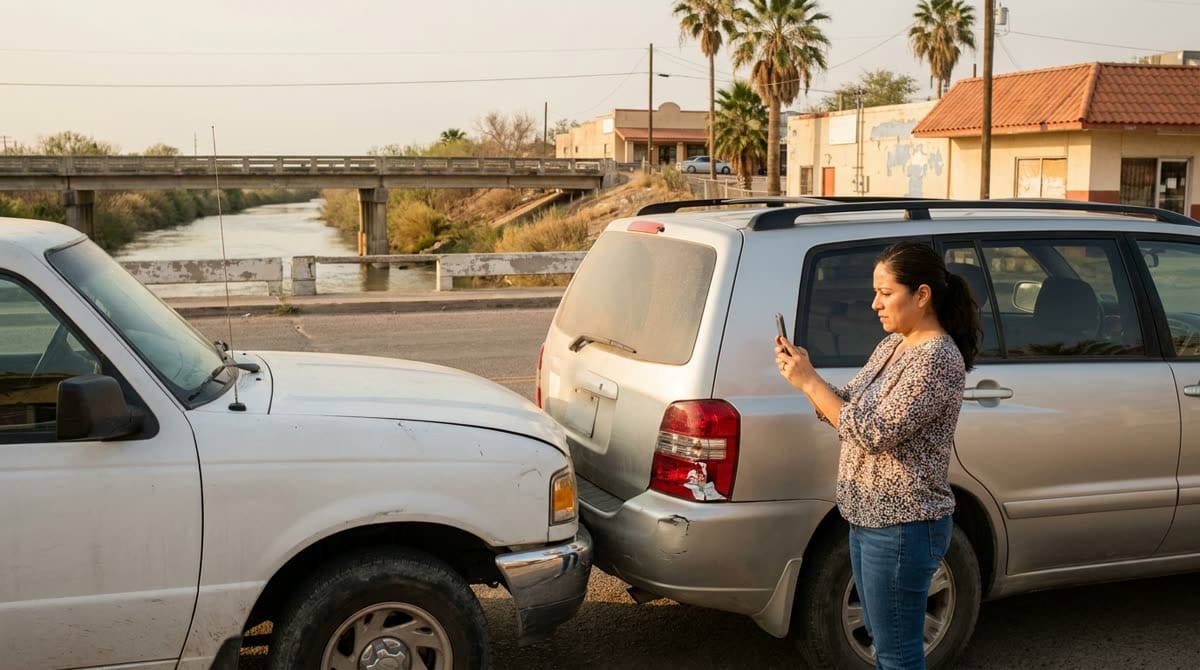
If a driver with Mexican plates hits you in Texas, their insurer pays only if the policy covers driving in the United States, and many Mexican policies don't. At the scene, call the police and photograph the entire policy. If there's no valid coverage, your own uninsured/underinsured motorist coverage (UM/UIM) and your PIP can pay your medical bills and lost wages. You can also sue the driver in Texas even if they live in Mexico.
In Eagle Pass, Laredo or Del Rio, crossing the bridge to run errands, work or visit family is part of daily life, which means border streets always carry cars with plates from Coahuila, Nuevo León or Tamaulipas. The vast majority drive carefully. But when one of those cars hits you, the next question is different from a normal crash: is their Mexican insurance any good here, and if not, who pays you?
The answer depends on one thing almost nobody checks at the scene: exactly what the other driver's policy says. Here's how to read it, what to do in the first minutes, and where the money can come from even if their insurer won't pay.
Is Mexican insurance valid in Texas?
Often it isn't. Most auto policies sold in Mexico cover only inside Mexico. Some more complete policies include liability coverage in the United States, and there are also tourist policies bought by the day for crossing. If the other driver's policy includes that coverage, their insurer has to answer for what they caused. If it doesn't, the policy is worthless in a Texas crash, even if it's current.
Texas law requires every vehicle on its roads to carry financial responsibility, no matter where the plates or the license are from. A driver on Texas roads without coverage that is valid here is driving uninsured, and for your claim they are treated as an uninsured driver.
Ask to see the other driver's policy and photograph every page. Look for language such as 'liability in the United States', 'USA' or 'coverage extension'. Also photograph the insurer's name, the policy number, the effective dates, their license and the plates. That information decides which way your claim goes.
What to do at the scene
- 1Call 911, even if the crash seems minor. The police report records who the other driver is, their address and what insurance they presented. When the driver lives in another country, that report is worth even more.
- 2Don't accept cash to settle it on the spot. It's a common offer. It covers today's bumper, not the injuries that show up days later, and it leaves no record.
- 3Take photos of both vehicles, the plates, the driver's license, the entire policy and the scene.
- 4Get witness information. If the driver later tells a different story, a local witness carries a lot of weight.
- 5Get medical care that same day or the next. Neck and back pain often shows up hours later.
- 6Notify your own insurer promptly. If the other driver has no valid coverage, your policy is the one that will pay, and almost all policies require prompt notice.
If their insurance won't pay: where the money comes from
The other driver lacking valid insurance here doesn't leave you without options. In Texas there are three sources worth checking, and many people have two of them without knowing it:
- Your uninsured/underinsured motorist coverage (UM/UIM). It's made for exactly this: it pays what the at-fault driver should have paid, including medical bills, lost wages, and pain and suffering. In Texas your insurer must offer it, and you only lack it if you rejected it in writing.
- Your PIP (personal injury protection). It pays medical bills and part of your lost wages regardless of who was at fault, and it covers your passengers too. Like UM, it's included unless you rejected it in writing.
- Your collision coverage, if you carry it, to repair your car while the rest gets resolved.
Don't wait for the insurance question to be settled before getting care. At Ruiz & Associates we connect you with doctors who treat you now and get paid at the end of your case. That way you don't let days pass without treatment, which is exactly what the insurer would later use to say you weren't badly hurt.
Can I sue someone who lives in Mexico?
Yes. When a driver who doesn't live in Texas has a crash here, Texas law allows them to be sued in Texas courts, and there's a special procedure to serve them even though they're out of state. The case is handled here because the crash happened here.
The hard part usually isn't suing, it's collecting. If the driver has no valid insurance and their assets are in Mexico, enforcing a judgment there is slow and not always possible. That's why, in practice, what matters most in these cases is identifying every coverage: the other driver's if it exists, yours, and that of any company involved.
What if it was a truck from a Mexican company?
That changes a lot. Mexican trucking companies that cross into the United States with cargo must carry insurance valid here, either per trip or annual, depending on how far from the border they operate. And when the driver is on the job, the company answers for them. That means in a crash with a Mexican commercial truck there is usually an insurer to file against, with limits far higher than a private car's.
If a tractor-trailer or work truck hit you, photograph the company name on the door, the USDOT number and the unit number. That's how the responsible party gets identified.
The mistakes we see most in these cases
- Taking cash at the scene and not calling the police.
- Photographing only the insurance card, not the policy that says where it covers.
- Not notifying your own insurer because 'it was the other driver's fault.'
- Letting days go by without medical care.
- Signing the other driver's insurer's paperwork without knowing what you're releasing.
How long do I have?
In Texas you generally have two years from the date of the crash to file an injury lawsuit. But in these cases it pays to move in days, not months: the other driver can return to Mexico and change addresses, and your own policy usually requires prompt notice before you can use your uninsured motorist coverage.
How Ruiz & Associates helps
We've spent more than 30 years working on the border, in Eagle Pass, Del Rio, Laredo, Carrizo Springs and across Southwest Texas, and crashes with drivers from Mexico are part of our everyday work. We review the other driver's policy, find your own coverages, file against the company if it was a work vehicle, and push back on your insurer if it tries to pay you less than what's fair. We speak Spanish, we answer personally, and we work on contingency: you pay nothing unless we win your case. The consultation is free and confidential.
Frequently asked questions
Does the other driver's Mexican insurance have to pay me?+
Only if their policy includes liability coverage in the United States. Many Mexican policies cover only in Mexico. That's why you should photograph the entire policy at the scene.
The driver had no valid Texas coverage. Am I left with nothing?+
Not necessarily. Your uninsured motorist coverage (UM/UIM) and your PIP can pay your medical bills, lost wages and more. In Texas they're included unless you rejected them in writing.
Can I sue a driver who lives in Mexico?+
Yes, in Texas courts, because the crash happened here. The hard part is usually collecting if they have no insurance or assets in the United States, which is why every coverage matters.
The other driver offered me cash not to call the police. Should I take it?+
Better not. Cash covers little and leaves no record. Without a police report it's harder to prove who was at fault and to file later if injuries appear.
A truck from a Mexican company hit me. Is there insurance?+
Usually yes. Trucking companies that cross with cargo must carry insurance valid in the United States, and the company answers for its driver. Photograph the company name and the USDOT number.
Is this your case? We cover it in depth
Every city has its own roads, hospitals and courts. If your accident happened in one of these, here's what applies where you are:
Were you in an accident? Tell us what happened.
Free, confidential consultation. No fee unless we win. Bilingual team available 7 days a week.
This article is for informational purposes only and does not constitute legal advice. Every case is different; past results do not guarantee future outcomes. Reading this content does not create an attorney-client relationship.