A Truck Swung Wide and Hit My Car in Texas: Who Is at Fault?
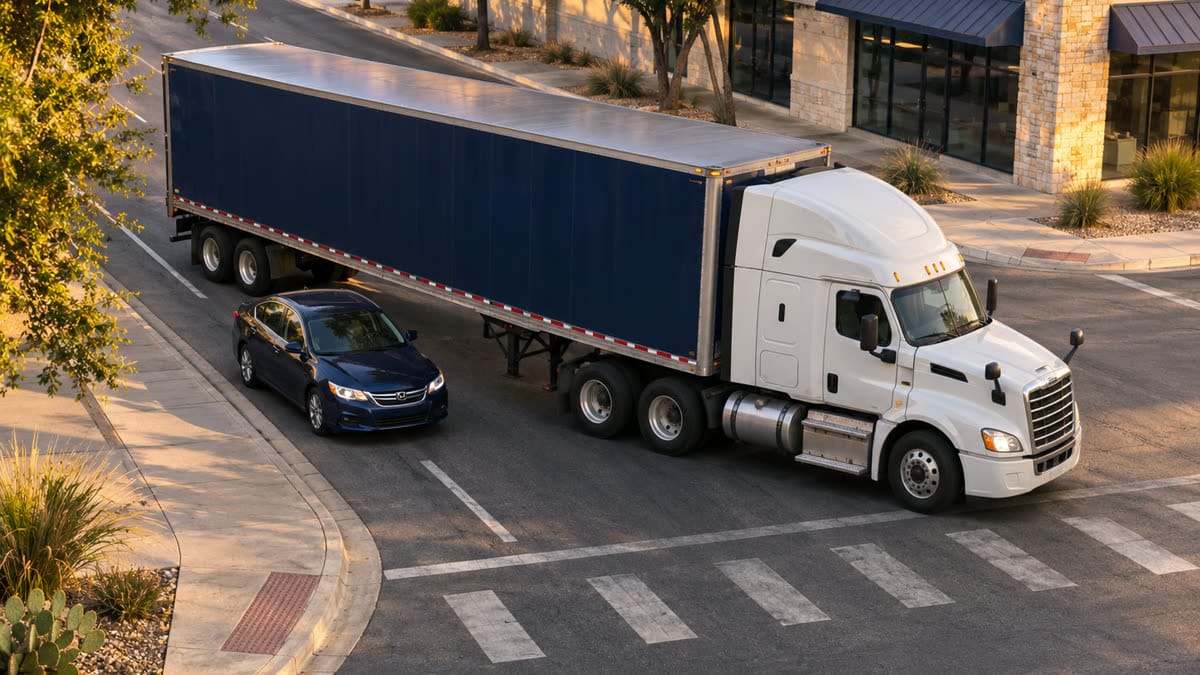
A Texas truck wide-turn crash requires reconstructing the full maneuver: both vehicles' positions, signals, available space and timing of contact. The truck's need for room does not decide fault, nor does an unsupported claim that the car passed on the right. If you were injured, seek medical attention and preserve relevant evidence.
You approach a corner behind a tractor-trailer. The truck moves left, making it look as though it will continue that way, but then turns right. The trailer closes toward your car and a collision follows. Calling it a wide turn describes a maneuver; it does not establish who was responsible.
If you were injured around Eagle Pass, Laredo or elsewhere in Texas, the full sequence matters more than which explanation the carrier gives first. A car already stopped near a corner is different from one attempting to pass through a narrowing gap. This guide explains the information needed to distinguish those situations.
What is a wide turn, and how can it reach a passenger car?
A tractor and its trailer do not move around a corner like a compact car. The trailer can follow a different path from the cab. Watching only the front of the truck can leave someone with an incomplete picture of the space the vehicle will occupy during the turn.
FMCSA explains that large vehicles need extra room and time to turn. A truck preparing to turn right may initially move left. A car between the truck and the corner may then be in a narrowing space. This describes a safety hazard, not a finding about the cause of any particular collision.
Identify which part of the truck made contact: cab, trailer side, trailer wheels or rear end. Those are different details. It is not helpful to label every sideswipe a wide-turn crash without checking whether the truck was actually turning, merging or changing lanes.
Does Texas law let a truck use any space it needs?
For a right turn at an intersection, Texas calls for the approach and turn to be as close as practicable to the right edge. Traffic-control devices may prescribe a different path.
The movement must be safe and signaled. For a turn, the signal must continue for at least the final 100 feet beforehand. A turn signal does not itself settle responsibility.
If the truck moved left, was I entitled to pass on its right?
Do not treat the resulting gap as an invitation to pass. FMCSA's safety guidance advises motorists to wait for the large vehicle to finish turning. After a crash, that prevention advice needs to be distinguished from the legal question of what each driver did.
An investigation needs to establish whether the car was already there, whether it was stopped, what lane was available and when the gap began to close. What each driver could observe also matters. The claim that you passed on the right must be checked against evidence, just as a claim that the truck trapped your car must be.
Which situations need to be distinguished before assigning fault?
| Observed situation | What to check | Assumption to avoid |
|---|---|---|
| The car was stopped near the corner | Its earlier position, traffic signals, markings and the complete truck path. | That being stopped alone resolves all the facts. |
| The car advanced on the truck's right | Lane availability, visible signals, speeds and the order of movements. | That every gap between a truck and curb is an available lane. |
| Both vehicles were turning | How many lanes allowed the turn and the marked paths. | That final positions show where both vehicles started. |
| The trailer reached the car after the cab passed | The contact point and each vehicle's earlier position. | That watching the cab alone revealed the trailer's full path. |
These are investigative questions, not fault findings or a reconstruction of a real client's crash.
A photograph taken after the vehicles moved can still help, but it should not be presented as showing their original positions. Recording when each image was taken makes it more useful. A careful investigation also identifies the details that remain unknown.
What evidence can clarify the complete maneuver?
Look for evidence of the seconds leading up to the turn, not just the moment of impact. A recording may show the truck's initial movement, when a signal appeared or whether the car was already stopped. Camera angles have limits: something not visible in one view should not automatically be treated as nonexistent.
- Original recordings: from your car, other vehicles or nearby businesses, including the period before and after contact.
- Roadway photographs: the corner, curb, lanes, arrows, signals and obstructions affecting the turn, taken without entering traffic.
- Damage and contact points: location, height and extent can help compare accounts, without deciding a claim from one photograph.
- Witnesses: where they were, what portion of the maneuver they observed and how to contact them.
- Truck identification: carrier, tractor and trailer, plates and visible numbers that help identify the units.
Save a complete recording and a backup rather than relying on a screenshot or social-media edit. If you know of a business with a camera, note the location and tell the attorney. Do not access someone else's equipment or systems without permission.
What should I do if I was injured?
Safety and medical attention come first. Call 911 for injuries or an emergency and follow responders' directions. Do not stay in a live lane to obtain a better picture or place yourself between the car and trailer.
- 1Get medical evaluation appropriate to your situation and accurately describe the crash and your symptoms.
- 2Keep medical records, prescriptions, receipts, appointments and documentation of injury-related missed work.
- 3Write down what you remember, separating what you saw from what others told you.
- 4Obtain incident information and save communications from insurers and the carrier.
- 5If receiving care prevented you from collecting evidence, explain that; a companion or later investigation may contribute information.
Car repairs and injury documentation are related but distinct. Check whether an offer concerns only vehicle damage or includes a release of personal-injury claims. Do not assume a modest property-damage payment is the only matter addressed in paperwork you are asked to accept.
Ruiz & Associates can discuss care options and connect you with doctors even if you have no health insurance. Ask how expenses would be handled in your situation; this does not mean all care is free.
Can the carrier be investigated as well as the driver?
Identify who operated the truck, who they worked for and what they were doing. Depending on the facts and relationships, the company may also need to be investigated. A logo or plate helps locate information but does not replace examining contracts, control and each party's conduct.
An attorney can assess which recordings and relevant records should be preserved. Availability depends on equipment and retention practices. Not every truck records every side of the vehicle, and a preservation request does not guarantee a recording exists or that the company must immediately provide it.
What if both drivers contributed?
For claims governed by Texas proportionate-responsibility rules, responsibility above 50% bars recovery; at 50% or less, recovery may be reduced proportionally. The allocation requires evidence. An adjuster's initial view is not a court's determination.
Accurately describe your own position and movement. If you cannot remember whether a turn signal was on, do not guess. If your car was moving, do not describe it as stopped. A difficult detail is not fixed by changing the story; it needs to be considered with the other facts and what can actually be established.
How can Ruiz review this kind of crash?
The review starts by organizing the maneuver and injury documentation. Date, location, photographs, a report or incident number, carrier details and communications you received can help. You do not need to invent a technical explanation if you do not yet know why the crash occurred.
Texas generally provides two years to bring a personal-injury lawsuit, with exceptions. That does not mean video will remain available for that entire period. Seeking advice early helps identify information worth preserving before it becomes harder to locate.
Ruiz & Associates handles car and truck accident cases from Eagle Pass, with Spanish and English assistance. We can review your situation and explain what still needs investigation. Consultations are free, and we work on a no-fee-unless-we-win basis without promising a specific outcome.
Official sources consulted
Sources checked on 2026-11-04. Application depends on the specific facts and claim.
- Texas Transportation Code §§ 545.101, 545.103 y 545.104 — https://tcss.legis.texas.gov/resources/TN/htm/TN.545.htm
- FMCSA: Tips for Passenger Vehicle Drivers — https://www.fmcsa.dot.gov/ourroads/tips-driving-safely-around-large-trucks-or-buses
- FMCSA: Tips for Truck and Bus Drivers — https://www.fmcsa.dot.gov/ourroads/tips-truck-and-bus-drivers
- Texas DPS: Commercial Driver Handbook (DL-7C) — https://www.dps.texas.gov/internetforms/getForm.ashx?id=DL-7C.pdf
- Texas Civil Practice and Remedies Code, Chapter 33 — https://tcss.legis.texas.gov/resources/CP/htm/CP.33.htm
- Texas Civil Practice and Remedies Code § 16.003 — https://tcss.legis.texas.gov/resources/CP/htm/CP.16.htm
- Texas Department of Insurance: Tips for auto insurance claims — https://www.tdi.texas.gov/tips/what-to-do-after-a-wreck.html
Frequently asked questions
Is the truck always at fault if it hits my car while turning?+
Fault is not automatic. The truck's path, both vehicles' earlier positions, signals and both drivers' conduct matter.
Does the truck moving left mean I can pass on the right?+
Do not assume the gap is available. It may be part of a right turn; after a crash, the use of that space and the sequence of events need to be reconstructed.
Are photographs useful if the vehicles had already moved?+
They may document damage and the setting. Clarify when they were taken so later positions are not confused with the vehicles' pre-impact positions.
How is this different from a lane-change crash?+
The focus here is the vehicle combination's path while turning a corner. A lane-change investigation concerns movement into an adjacent lane. Some crashes may involve both movements.
Can Ruiz review a crash in Eagle Pass or Laredo?+
Yes. Ruiz & Associates handles car and truck accident cases in Texas, with free consultations and bilingual assistance.
Is this your case? We cover it in depth
Every city has its own roads, hospitals and courts. If your accident happened in one of these, here's what applies where you are:
Were you in an accident? Tell us what happened.
Free, confidential consultation. No fee unless we win. Bilingual team available 7 days a week.
This article is for informational purposes only and does not constitute legal advice. Every case is different; past results do not guarantee future outcomes. Reading this content does not create an attorney-client relationship.