A Truck Caused a Chain-Reaction Crash in Texas: Who Pays for My Injuries?
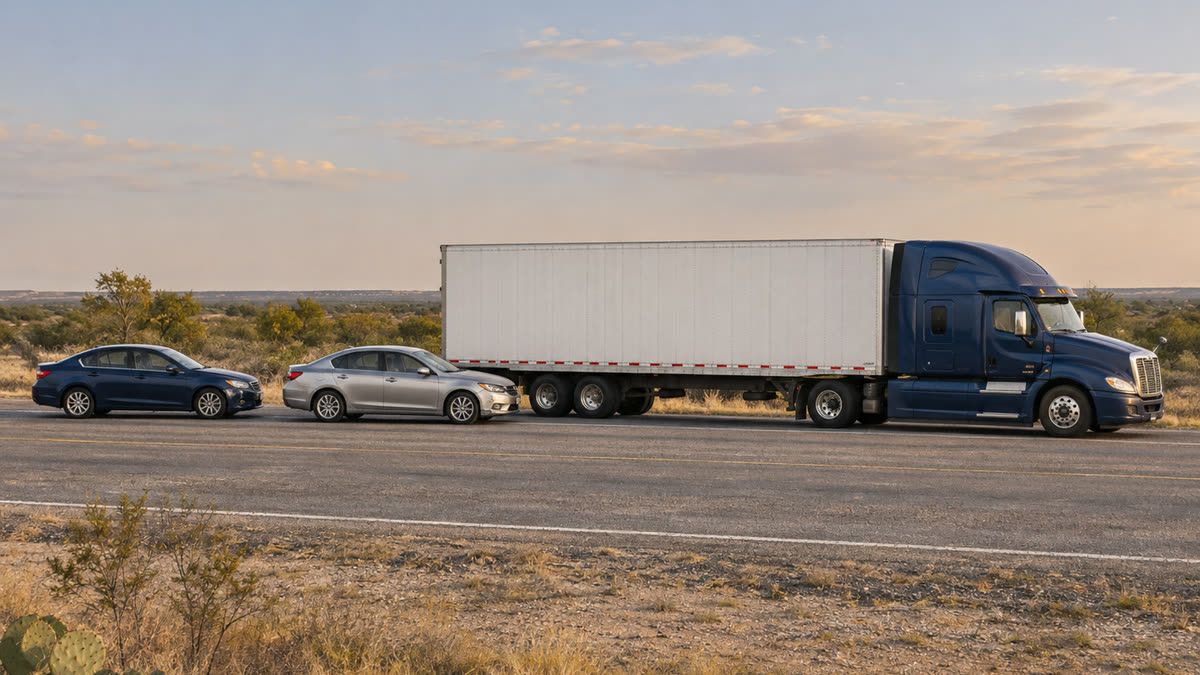
Responsibility depends on how each driver's actions contributed to the crash and your injuries. Counting vehicles or automatically blaming the last driver is not enough. The impact sequence, evidence and potentially relevant insurance coverage need individual examination.
Your car is hit, pushed forward and left against another vehicle. A truck is nearby, several people are injured and the accounts conflict. One insurer says its driver had already stopped; another says someone else caused the first impact. If you were injured, you need more than a dispute about who ended up at the back.
A chain-reaction collision is not simply a rear-end accident with additional cars. It may involve separate impacts, drivers who stopped successfully and vehicles pushed into others. This guide explains information worth preserving and questions that help investigate a Texas injury claim.
Start by reconstructing the order of the impacts
Final vehicle positions matter, but do not tell the whole story. The first contact must be distinguished from later impacts. An intermediate car may already have collided or may have been pushed. If you remember two impacts, describe them without assigning a source you could not see.
| Question | Information that may help |
|---|---|
| Who made the first contact? | Complete recordings, witness accounts and damage consistent with the sequence. |
| Had the middle car already stopped? | Spacing, earlier braking and observations from approaching drivers. |
| Was there one impact or more? | Occupant accounts, recordings and technical review when needed. |
| Were the vehicles moved afterward? | Early scene photographs, the report and an explanation of the move. |
A photograph of damaged bumpers may show contact points without proving who started the entire sequence. Speed should not be reconstructed from a casual visual estimate either. A question that requires technical analysis should be treated accordingly.
Is the last driver always responsible?
That explanation should not be accepted automatically. Texas requires safe following distance and reasonable speed for the conditions. Responsibility also requires establishing what each person did and how the conduct contributed to the harm.
For example, a driver may have stopped before being pushed into the next car. Another may have caused an independent impact before the truck arrived. These are hypothetical examples, not findings about your collision. The evidence must establish what actually happened.
The truck's size does not settle fault either. Attention, braking, following distance, equipment condition and other relevant circumstances may need examination. A carrier is not automatically liable simply because one of its vehicles appears at the scene.
What to preserve before accounts become mixed together
Address the emergency and your medical needs first. If information can be documented safely, identify all involved vehicles. Do not walk between lanes or behind moving traffic for another photograph. Other sources may still help if you could not take pictures.
- Original recordings: preserve the complete recording, including events before the first impact.
- Witness details: note where each person was and which part of the sequence they observed.
- Vehicle identification: available plates, unit numbers and information identifying the tractor, trailer and operator.
- Report and incident details: keep the report number and investigating agency.
- Your own recollection: record what you perceived and distinguish it from what others later told you.
There is no universal deletion deadline for every camera or device. Identify possible recording sources promptly. A lawyer can review preservation requests appropriate to the circumstances; you do not need to obtain company records yourself.
Each injured person needs an individual record
A vehicle-damage file is not a substitute for each occupant's medical documentation. Describe events and symptoms accurately to your treating professionals and follow their instructions. Preserve bills, visits, receipts, restrictions and records of missed work.
If a symptom appeared or changed after a second impact, explain that honestly. You do not need to offer a medical opinion identifying which impact caused a particular injury. That connection may require professional assessment and examination of the records.
Passengers should preserve their seating location and available vehicle information. Do not assume the driver's negotiation includes your injuries or that a payment for repairs automatically resolves every occupant's claims.
Several insurers do not mean automatic payments
There may be different drivers, owners, operators and policies. Each potentially responsible party and relevant coverage must be identified. Multiple insurers do not guarantee that all owe payment or that sufficient coverage exists for every claimed amount.
Texas OPIC distinguishes a claim under your own policy from one against another person's insurer. A denial may concern fault, coverage or missing information. Ask what the stated reason is and preserve the correspondence.
When multiple people are injured, policy limits and conditions deserve particular attention. Before accepting an amount, examine the losses it addresses, who it releases and how it affects your position. Separate your injuries from vehicle damage and other occupants' settlements.
What if you are assigned part of the fault?
For cases governed by Texas Chapter 33, recovery is reduced by the injured person's share of responsibility and barred if that share exceeds 50%. An insurer's proposal is not a court finding.
A chain-reaction crash can involve more than two potentially responsible people. Percentages should not be assigned by intuition. Preserve the differing accounts and avoid signing someone else's description if it does not reflect what you know.
If it happened near Eagle Pass, Del Rio or Laredo
Record the highway, direction, intersection or mile marker. On US-57, US-277 or I-35, saying you were heading toward Laredo is not an exact location. Note traffic queues, temporary signs or other conditions you remember without treating them as automatic proof of fault.
Distinguish the first impact location from the vehicles' final positions. Explain any movement made for safety. Timed photographs and available phone locations may help organize the evidence without requiring you to return to a dangerous roadway.
Before accepting an offer or considering the case closed
- 1Get the care you need and preserve the records.
- 2Organize original videos, photographs and witness details.
- 3Identify each insurer and the claim addressed in its correspondence.
- 4Have the sequence and your losses reviewed before accepting fault percentages or a release.
- 5Check applicable deadlines rather than waiting for every adjuster to agree.
Texas has a general two-year limitations period for personal-injury lawsuits, with exceptions. Negotiations and the availability of recordings are separate issues. Early review helps identify what should be done while evidence may still be located.
Official sources
Consulted November 18, 2026. The cited rules depend on the circumstances and type of claim.
- Texas Transportation Code, §§545.062 and 545.351 — https://tcss.legis.texas.gov/resources/TN/htm/TN.545.htm
- Texas Civil Practice and Remedies Code, Chapter 33 — https://tcss.legis.texas.gov/resources/CP/htm/CP.33.htm
- OPIC: third-party auto claims — https://www.opic.texas.gov/auto-insurance/third-party-claims/
- Texas Civil Practice and Remedies Code, §16.003 — https://tcss.legis.texas.gov/resources/CP/htm/CP.16.htm
Frequently asked questions
Is the last driver always liable in a pileup?+
Not automatically. Investigators need to establish who caused each impact and whether other vehicles had already collided, stopped or been pushed. Final positions alone do not resolve the sequence.
My car was pushed into another car. Should I accept fault?+
Describe what you remember, but do not replace investigation with automatic acceptance. Recordings, witnesses and damage review may help establish whether another vehicle pushed you.
Does the driver's settlement also cover an injured passenger?+
Do not assume so. The parties and released claims must be reviewed. Each occupant should document individual injuries and establish how their own position is addressed.
Can multiple insurance policies be investigated?+
Yes, where the facts justify it. Responsibility, coverage and limits must be checked. More insurers do not guarantee payment or allow double recovery for the same loss.
What should I bring if I do not have video?+
Bring medical documents, the report number, available photographs, witness details and insurer correspondence. Do not delay care or expose yourself to danger to complete the file.
Is this your case? We cover it in depth
Every city has its own roads, hospitals and courts. If your accident happened in one of these, here's what applies where you are:
Were you in an accident? Tell us what happened.
Free, confidential consultation. No fee unless we win. Bilingual team available 7 days a week.
This article is for informational purposes only and does not constitute legal advice. Every case is different; past results do not guarantee future outcomes. Reading this content does not create an attorney-client relationship.