I Hit a Stopped Truck in Texas: Can I File an Injury Claim?
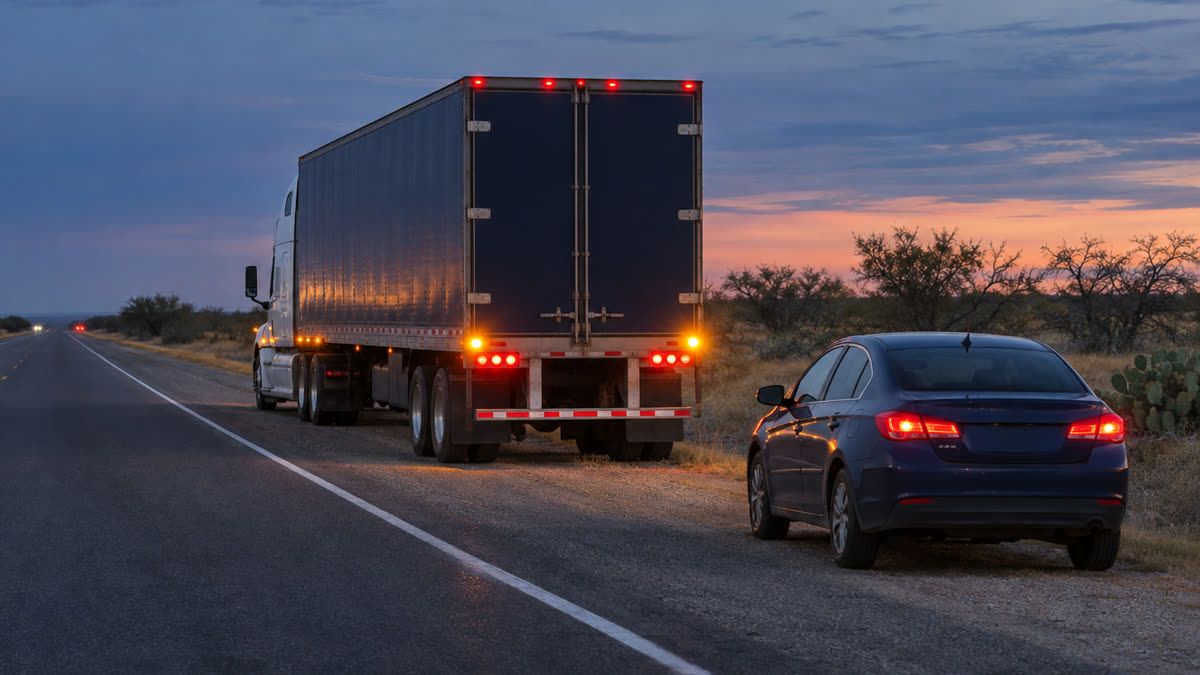
You may have an injury claim if the truck’s location or missing warnings contributed to the collision. Your own driving must also be investigated: a stationary truck, or a rear impact by your car, does not by itself settle responsibility.
You notice the trailer too late. After the impact, the explanation sounds final: “The truck was stopped. You hit it.” If you were injured, that statement cannot replace an investigation. Why the truck stopped, how long it had been there and what approaching drivers could see all need to be established.
This guide is for people injured in collisions with commercial vehicles in Texas. It explains information that may change the responsibility analysis, without assuming that every breakdown is negligent or every rear impact is entirely the passenger-car driver’s fault.
Was the truck stopped for traffic, disabled or parked?
Start with that distinction. A truck braking because traffic has stopped is in a different situation from one disabled by a mechanical failure. A driver’s decision to park creates another scenario. The reason for the stop helps determine which rules and records need examination.
| Situation | What to examine | What not to assume |
|---|---|---|
| A necessary traffic stop | Traffic queues, signals, earlier braking and the impact sequence. | That a driver must get out and place warning devices in a traffic queue. |
| Breakdown or emergency | When the failure occurred, vehicle position, warnings and assistance requested. | That a mechanical failure removes every duty to warn. |
| Parking or a rest stop | The chosen location, posted restrictions and opportunities to stop outside the lane. | That a stationary vehicle is safe or permitted in any location. |
The timeline matters as much as the final photograph. A truck that stopped moments earlier and one that had remained there for a longer period can look identical after a crash. Complete recordings, assistance calls and dispatch records may help distinguish them.
What warnings may be required for a stopped truck?
Where 49 CFR 392.22 applies, a stop on the highway or shoulder other than a necessary traffic stop requires immediate hazard flashers. The general rule also requires warning devices as soon as possible, within ten minutes at the latest. That outside limit is not permission to wait without acting.
Hazard lights do not replace required devices. Special rules address location and visibility, including certain municipal districts. Applicability to the vehicle and operation must be checked first. Not every stop carries identical requirements.
A picture of illuminated lamps after the impact does not show that they were operating beforehand. Likewise, a cropped photograph without a warning device does not establish that no device was present. Preserve the original sequence and record when and where each image was made.
What if the trailer was in the lane or on the shoulder?
Texas Transportation Code §545.301 regulates stopping on the main traveled part of a highway outside business or residential districts. It includes conditions and exceptions, including a disabled vehicle whose temporary stop on the roadway cannot be avoided. The location and reason for stopping must be considered together.
To reconstruct its position, examine the white edge line, available width and any part of the trailer occupying the travel lane. “It was off to the side” is too vague if it does not establish where the wheels or rear end were.
Being entirely outside the lane does not answer every question either. The investigation must establish how contact happened and whether positioning, visibility or another circumstance contributed. It must also examine why the car approached the shoulder, without filling evidentiary gaps with assumptions.
What evidence should you preserve without risking another collision?
Address the emergency first. Call 911 when people are injured or the roadway presents danger, and follow emergency responders’ directions. Do not step into a lane, walk behind a trailer in moving traffic or return to the impact point simply to get another picture. Someone else may document information if it is safe.
| Information | What it may help establish |
|---|---|
| Complete original recordings | The approach, when the truck stopped and warnings visible before impact. |
| Wide scene photographs | The relationship between lane, shoulder, curves, lighting and vehicle positions. |
| Tractor and trailer identification | Which equipment was involved and which companies need identification, without assuming they are the same. |
| Witness names and contact details | What they saw before the collision and from where, beyond its aftermath. |
| Report number and investigating agency | Where to locate the investigation record and identify the incident. |
| Assistance requests and operational records | The breakdown timeline, notifications, dispatch and assistance, if records exist and are obtained appropriately. |
Keep files as received instead of replacing them with compressed screenshots or edited clips. Note who may have a camera covering the approach. You do not need to obtain the carrier’s internal documents personally: a legal review can identify what to request and how preservation should be addressed.
There is no single deletion schedule for every camera, device and company. That makes early identification of sources useful, without promising that a “black box” will always exist or resolve the case by itself. The relevant evidence may be distributed among several people or systems.
Your injuries need their own documentation
Documenting the truck does not replace documenting what happened to you. Seek medical care according to your needs and describe the collision, symptoms and changes accurately. Follow your treating professionals’ instructions. Keep records, bills, receipts and communications relating to your care.
If you missed work, preserve absence dates, medical restrictions and available income records. Separate expenses already incurred from future estimates. Vehicle damage does not by itself measure an injury, and a list of bills does not automatically establish who caused the collision.
If you were a passenger, document where you were sitting and your own symptoms. Each occupant’s injuries and losses need individual consideration. Do not assume another person’s settlement also resolves your situation. Keep any correspondence addressed to you so your own position can be reviewed.
The carrier says everything was my fault. Is that the end of it?
No. A driver’s, adjuster’s or witness’s account must be tested against the evidence. The truck driver’s decisions matter, as do the car driver’s speed, attention and path. An analysis should explain how each action contributed to the harm, rather than stop at which vehicle was moving.
For cases governed by Texas Chapter 33, responsibility greater than 50% bars recovery; when that threshold is not exceeded, recovery is reduced by the assigned share. An insurer’s proposed percentage is not a court’s finding.
Before accepting an offer, examine whether it addresses only property damage or also injuries and other losses. Keep the proposal and any documents you are asked to sign. Explain what you remember honestly, and avoid guessing about details you do not know.
Who needs to be identified beyond the driver?
The investigation may need to identify the motor carrier, tractor owner, trailer owner and those involved in maintenance or assistance. Multiple company names do not establish that every company is liable. Each possible claim needs a specific connection between conduct, the collision and the injuries.
For example, a failure described by the driver may justify examining maintenance and repair requests. A stop directed by dispatch may make communications relevant. Those are investigative questions, not facts to assert without records or a review of the circumstances. The analysis should remain specific to the equipment and people actually involved.
If the collision happened near Eagle Pass, Del Rio or Laredo
Record the highway, travel direction and a precise reference such as an access point, exit, intersection or mile marker. If it happened on US-57, US-277 or the I-35 corridor, the highway name alone does not locate the stopped truck.
Distinguish the impact location from wherever the vehicles were moved afterward. If you have a phone location, preserve it with its time. Do not return to measure the shoulder yourself. Do not assume the agency that first received a call necessarily completed the investigation: keep the incident number and confirm the record.
What to do now if you were injured
- 1Address your medical needs and follow emergency instructions.
- 2Preserve original recordings, photographs, reports and witness information already available.
- 3Keep treatment documents, expenses and evidence of missed work.
- 4Get responsibility reviewed before accepting “it was stopped, so you pay” as the final answer.
- 5Review settlement offers and claim releases before signing.
Texas has a general two-year limitations period for personal-injury lawsuits, with exceptions that can change the analysis. That period does not guarantee the evidence will remain available. Have the dates and requirements relevant to your circumstances reviewed promptly.
Official sources
Rules and materials consulted on November 11, 2026. Each rule must be evaluated against the facts and its scope of application.
- 49 CFR 392.22: emergency signals for stopped commercial motor vehicles — https://www.ecfr.gov/current/title-49/subtitle-B/chapter-III/subchapter-B/part-392/subpart-C/section-392.22
- FMCSA: emergency warning devices — https://csa.fmcsa.dot.gov/SafetyPlanner/MyFiles/SubSections.aspx?ch=23&sec=68&sub=168
- Texas Transportation Code, §545.301: stopping outside business or residence districts — https://tcss.legis.texas.gov/resources/TN/htm/TN.545.htm
- Texas Civil Practice and Remedies Code, §§33.001 and 33.012: proportionate responsibility — https://tcss.legis.texas.gov/resources/CP/htm/CP.33.htm
- Texas Civil Practice and Remedies Code, §16.003: general personal-injury limitations period — https://tcss.legis.texas.gov/resources/CP/htm/CP.16.htm
Frequently asked questions
Am I always at fault if I hit the truck from behind?+
Fault is not automatic. The truck’s location, reason for stopping, warnings and the car driver’s actions need examination. Responsibility requires evidence of how each action contributed to the collision.
Are hazard lights enough to warn that the truck is stopped?+
Where 49 CFR 392.22 applies, flashers do not replace required warning devices. Special rules address location and visibility, so the particular obligation must be evaluated for the situation.
What if the truck had stopped less than ten minutes earlier?+
Elapsed time matters, but does not settle fault by itself. The applicable rule requires action as soon as possible. Location, warnings and the circumstances of the stop also need examination.
Can my case be reviewed if the truck was on the shoulder?+
Yes. The exact position and paths of the vehicles, visibility and cause of contact must be reconstructed. Being on the shoulder does not establish either liability or freedom from liability by itself.
What should I bring to a consultation about my injuries?+
Available original recordings and photographs, the report number, witness details, truck identification, medical documents and insurance offers. Do not expose yourself to danger or delay care to assemble a perfect file.
Is this your case? We cover it in depth
Every city has its own roads, hospitals and courts. If your accident happened in one of these, here's what applies where you are:
Were you in an accident? Tell us what happened.
Free, confidential consultation. No fee unless we win. Bilingual team available 7 days a week.
This article is for informational purposes only and does not constitute legal advice. Every case is different; past results do not guarantee future outcomes. Reading this content does not create an attorney-client relationship.