A Truck Moved Into My Lane and Hit Me in Texas: How Do I Prove Fault?
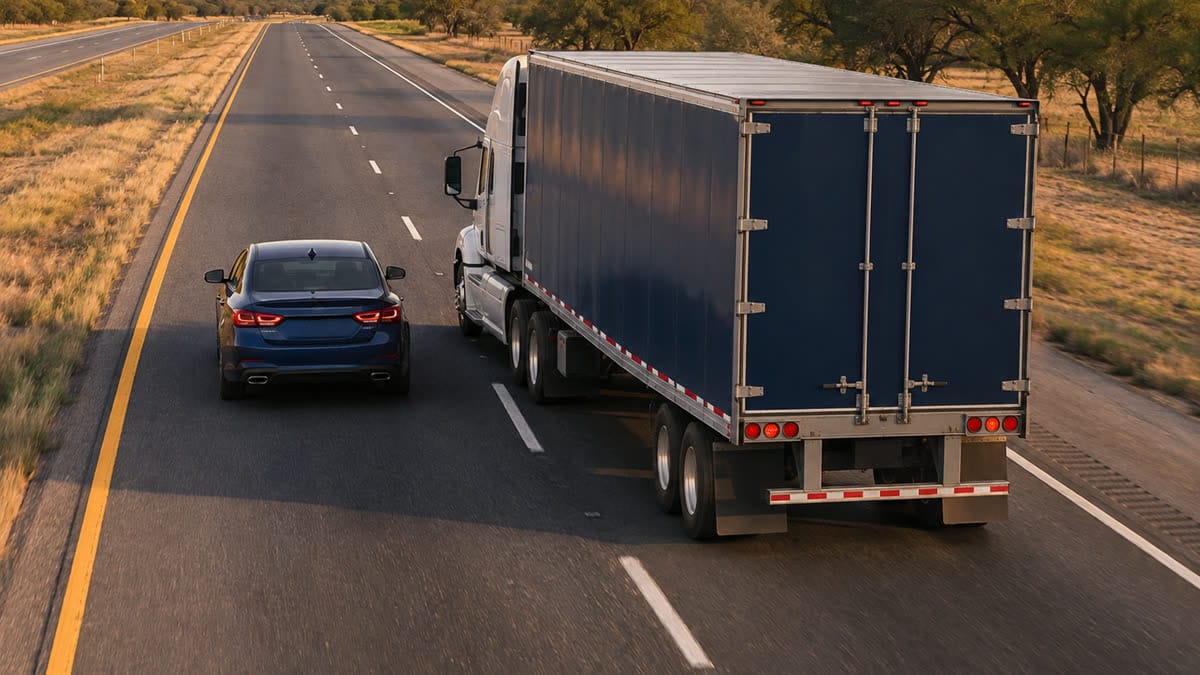
If a truck enters your lane in Texas, fault is investigated through the crash sequence, video, witnesses and damage. A claim that you were in a blind spot does not decide responsibility. If you were injured, seek medical attention and act promptly to request preservation of relevant evidence.
You are driving alongside a tractor-trailer when it starts moving into your lane. After the collision, the driver says they never saw you. The insurer offers a different account: you accelerated, tried to pass or changed lanes yourself. Meanwhile, you are dealing with pain, medical appointments and time away from work.
For someone injured around Eagle Pass, Laredo or South Texas, explaining what you remember is only the beginning. The accounts need to be checked against evidence. This guide focuses on truck lane-change and lane-encroachment crashes; it does not assume every collision has the same cause or outcome.
Who had to make sure the lane change was safe?
Texas transportation law requires drivers to stay within a lane as nearly as practical and move out of it only when safe. It also requires signaling an intended lane change. Using a turn signal does not itself give a truck priority over a car already in that space. These rules help frame an investigation; they do not automatically decide an individual claim.
The investigation needs to establish which vehicle moved sideways, when the maneuver began and what space was available. A truck entering an occupied lane is different from two vehicles trying to enter the same lane or a collision at a merge. The actual sequence matters more than an assumption that the larger vehicle must always be at fault.
Does being in a blind spot make the crash my fault?
That fact alone does not decide it. FMCSA warns that large trucks have limited-visibility areas and advises motorists not to linger in them. A safety warning is not a finding about who caused a particular crash. Both drivers' conduct and the available evidence still need to be examined.
If an adjuster relies on a blind-spot explanation, ask what supports it. Does video show where you were before the truck moved? Was there an independent witness? Is there information about the mirrors? A driver's statement that they could not see you should not replace an investigation.
Which evidence can show who crossed into the other lane?
Useful evidence helps put the moments before, during and after contact in order. A photograph may establish damage without showing which vehicle moved first. Investigators compare several sources, including information that may challenge the initial account.
| Evidence | What it may show | Its limits |
|---|---|---|
| Original camera footage | Vehicle positions, sideways movement and the sequence before impact. | A short clip may leave out how the maneuver started. |
| Independent witnesses | What they observed and their viewing position. | Their view may have been incomplete. |
| Damage and roadway photographs | Contact location, lanes and road markings. | One damage pattern does not resolve every issue. |
| Available electronic records | Speed, braking or other events, depending on equipment. | Not every truck records video, signals or sideways movement. |
| Police investigation and report | Identification, observations and the crash diagram. | It does not replace reviewing the full evidence. |
These are potential investigative sources. Availability and significance vary by crash.
Keep the full camera file, including the minutes before and after the collision. Save the original without editing it or posting it online. Record which device produced it and make a backup. A copy sent through a messaging app can be helpful, but it should not be your only copy if the original is still available.
What can you safely do at the scene?
If anyone is injured, call 911 and follow emergency responders' directions. Safety and medical care come first. Do not remain in a live lane or chase a truck to take a photograph. If you cannot collect information, a companion may be able to help from a safe location.
- 1Identify the tractor and trailer separately: plates, the carrier's visible name and unit or USDOT numbers, if they can be photographed safely.
- 2Photograph vehicle damage, lane markings, nearby merges or exits and the direction of travel without exposing yourself to traffic or disturbing the scene.
- 3Get witnesses' contact details and note where they were. Do not tell them what they should say.
- 4Write down the time, location and responding agency. Ask for the report or incident number.
- 5Describe what you actually perceived. Do not guess at speeds, distances or movements you did not see.
When making notes later, distinguish what you observed from what someone told you and what you do not know. It is better to acknowledge a missing detail than fill it with an assumption. An accurate account can include uncertainty; it does not have to sound rehearsed.
Which carrier records should be preserved promptly?
An attorney can assess who should receive a preservation request and which materials to identify: recordings, vehicle data, trip-related communications and relevant driving or maintenance records. A preservation letter does not guarantee a recording exists or by itself require the company to hand over every document. Obtaining records may require further procedures.
Retention periods differ. FMCSA requires six months for the driver-duty records and supporting documents covered by its rule. That does not mean every camera or engine module keeps all information for six months. ELD hours-of-service records and engine data are different sources; calling both a single 'black box' can be misleading.
A request should identify the crash and relevant materials as specifically as possible, including date, time, units, location and potential devices. Do not access company systems or interfere with the truck yourself. If one source does not exist, the investigation must use others rather than inventing what it would have shown.
Is a police report blaming the truck driver enough?
The report matters, but it needs to be considered with the rest of the record. TxDOT provides a system through which authorized people can obtain a CR-3 crash report. Check the vehicles, direction of travel, diagram and observations, distinguishing the officer's observations from the drivers' statements.
If you identify a possible error, preserve the evidence and ask how to raise it with the agency that prepared the report. Do not alter the document or assume one entry binds an insurer or court. Likewise, a report prepared before a video was found does not make the later evidence irrelevant.
What if the insurer says I share responsibility?
For claims governed by Texas proportionate-responsibility rules, a claimant whose responsibility exceeds 50% cannot recover damages; recovery at 50% or less may be reduced proportionally. An allocation needs factual support. An adjuster's initial position is not a court's determination.
Consider a hypothetical example: after impact, both vehicles may end up on one side of a lane line even though they were in separate lanes before contact. Their final positions alone do not explain the entire sequence. Ask what supports a fault assessment and compare it with video, damage and witness accounts without assuming an outcome.
How do I document injuries and handle insurance calls?
Get medical evaluation appropriate to your situation and follow the treating professional's instructions. Accurately describe the crash and your symptoms without exaggerating or minimizing them. Keep records, bills, appointments and evidence of missed work. A lost-income claim needs documentation of the loss rather than a rough assumption.
Ruiz & Associates can discuss care options and connect you with doctors even if you have no health insurance. Ask how expenses would be handled in your situation; this does not mean all care is free.
Notify your own insurer as required by your policy and meet the obligations that apply. The trucking company's insurer and your own insurer do not necessarily have the same relationship with you. Before providing a recorded statement or signing a broad authorization, clarify who is asking, why and what it covers; seek guidance if you are unsure.
An offer to repair the car is not necessarily the same as a release of injury claims. Read the document actually being presented. Evaluating a case requires connecting fault, injury and documented losses; visible damage to a vehicle cannot establish a promised recovery or result.
When should I ask for a case review?
Texas generally provides two years to bring a personal-injury lawsuit, with exceptions and other rules that may affect the analysis. That period is different from the time available to preserve a recording or comply with policy obligations. Seek an early review if there are injuries, conflicting accounts or uncertainty about who operated the truck.
Ruiz & Associates handles car and truck accident cases from Eagle Pass and offers bilingual assistance. We can review the lane-change sequence, identify potential responsible parties and explain what information is still needed to evaluate your situation. Consultations are free, and we work on a no-fee-unless-we-win basis. The review starts with the facts of your crash, without promises about the outcome.
Official sources consulted
Sources checked on 2026-11-02. The cited rules must be applied to the particular facts and type of claim.
- Texas Transportation Code, §§ 545.060, 545.103 y 545.104 — https://tcss.legis.texas.gov/resources/TN/htm/TN.545.htm
- Texas Civil Practice and Remedies Code, Chapter 33 — https://tcss.legis.texas.gov/resources/CP/htm/CP.33.htm
- Texas Civil Practice and Remedies Code, § 16.003 — https://tcss.legis.texas.gov/resources/CP/htm/CP.16.htm
- FMCSA: Tips for Passenger Vehicle Drivers — https://www.fmcsa.dot.gov/ourroads/tips-driving-safely-around-large-trucks-or-buses
- FMCSA: Retention of records of duty status and supporting documents — https://www.fmcsa.dot.gov/hours-service/elds/how-long-must-motor-carriers-retain-records-duty-status-rods-and-supporting
- TxDOT: Crash reports and records — https://www.txdot.gov/data-maps/crash-reports-records.html.html
- Texas Department of Insurance: Tips for auto insurance claims — https://www.tdi.texas.gov/tips/what-to-do-after-a-wreck.html
Frequently asked questions
Is the driver cleared of fault just because they say I was in a blind spot?+
That statement does not decide responsibility. The maneuver, both vehicles' positions and the available evidence need to be examined.
Can the crash be investigated if I have no dashcam?+
Yes. Witnesses, other vehicles' or businesses' cameras, photographs and relevant records may be available. Their existence or what they will show should not be assumed.
Do ELD logs and engine data show the same information?+
No. Hours-of-service logs and engine records serve different purposes. What can be obtained depends on the equipment, preservation and applicable procedures.
Should I sign the paperwork sent by the trucking company's insurer?+
Understand its scope first, particularly if you were injured. An authorization or release can affect rights beyond vehicle repairs; get guidance about the specific document.
Can Ruiz review my crash in Eagle Pass or Laredo?+
Yes. Ruiz & Associates handles car and truck accident cases in Texas, with Spanish and English assistance and free consultations.
Is this your case? We cover it in depth
Every city has its own roads, hospitals and courts. If your accident happened in one of these, here's what applies where you are:
Were you in an accident? Tell us what happened.
Free, confidential consultation. No fee unless we win. Bilingual team available 7 days a week.
This article is for informational purposes only and does not constitute legal advice. Every case is different; past results do not guarantee future outcomes. Reading this content does not create an attorney-client relationship.