Motorcycle Accident Lawyer in Texas
Cars turning in front of you, lane changes without looking, gravel on the road, parts that fail. More than 30 years putting the blame where it belongs.
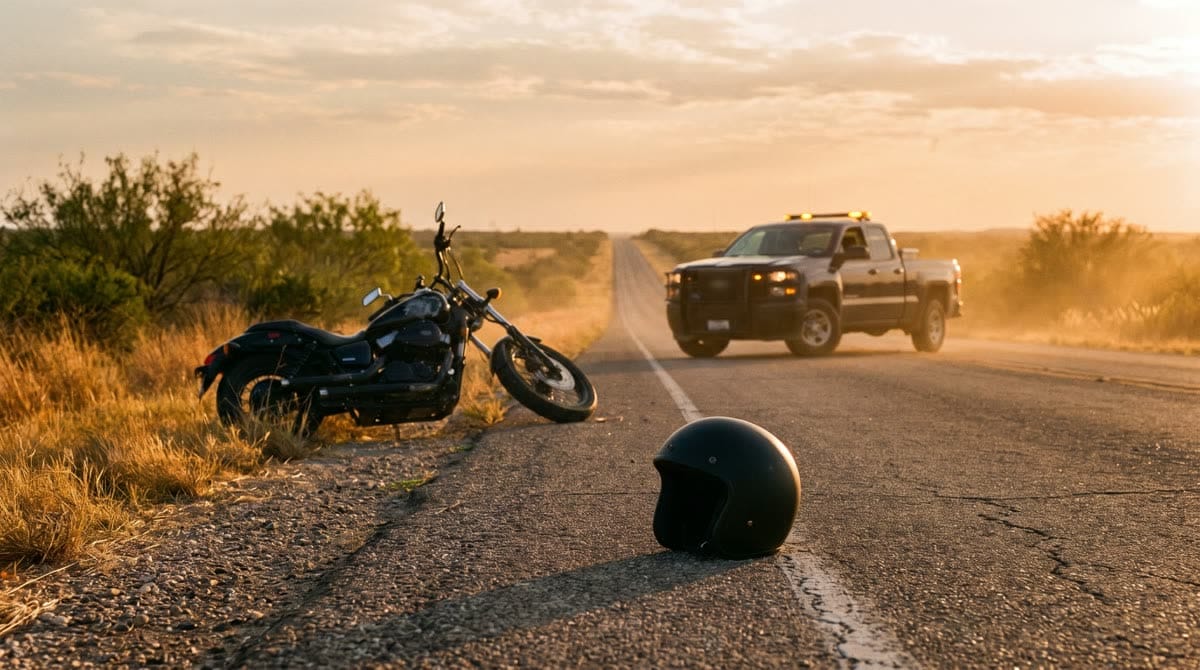
If you were hurt on your motorcycle in Texas because of someone else, the responsible party may be the driver who failed to yield, the company that owns the vehicle that hit you, whoever left a hazard on the road, or the manufacturer of a part that failed. The insurer will start by assuming you were at fault, so these cases are won with physical evidence that disappears within days. You have 2 years to file, and you recover as long as your share of fault doesn't exceed 50%.
In a crash between a car and a motorcycle, the one who goes to the hospital is almost always the rider. With no body panel or airbag, the injuries are different: fractures, deep road rash that needs skin grafts, head injuries even with a helmet, months out of work.
Then comes the second hit. The rider is treated like a suspect from day one. The adjuster, and sometimes even the officer writing the report, start with the idea that you were speeding. That bias isn't the law, but it weighs as if it were, and it's taken apart with proof.
Here's who is liable depending on how it happened, what the insurer will try, and what needs to be preserved in the first hours.
Who is liable in a motorcycle accident?
It depends on how it happened. These are the scenarios we see most in Southwest Texas, and several involve more than one responsible party:
It's the most common motorcycle crash. In Texas, a driver turning left must yield to vehicles coming from the opposite direction. If they cut across, the duty they failed was theirs, even if they say the bike 'came out of nowhere.'
A blind spot isn't an excuse. Before changing lanes, backing out of a driveway or pulling out of a business, the driver has to make sure the way is clear. A motorcycle is narrow, but it's there.
For a car it's a bumper tap. For a motorcycle stopped at a light, it means being thrown. The driver behind had the duty to keep distance and brake in time.
If the driver who hit you was driving for their employer, the company answers for them, and its insurance is usually much larger than a private driver's.
A pothole you don't feel in a car puts a motorcycle down. If a contractor left the gravel or a truck dropped its load, they're liable. If the defect is in the road itself, the government is sometimes liable, with very strict notice rules.
If a part was defective, or a bad repair left it unsafe, the manufacturer or the shop can be liable.
What the insurer will try
Nearly every move aims at raising your percentage of fault. In Texas, above 50% you recover nothing:
It's the first thing they say and they rarely prove it. Speed is reconstructed from pavement marks, damage and where the vehicles came to rest, not from the opinion of the driver who cut across.
Severity comes from the lack of protection, not necessarily from speed. A low-speed impact that's just a scare in a car can break bones on a motorcycle.
In Texas a helmet is required under 21. Riders 21 and older may ride without one if they completed an approved safety course or carry health insurance that covers accident injuries. And even without one, it doesn't change who caused the crash. How it affects the claim depends on the type of injury.
Lane splitting isn't allowed in Texas, and if it happened it should be disclosed from the start. But it doesn't hand you all the blame: if the car changed lanes without looking, their share is still there, and you recover as long as yours doesn't exceed 50%.
Some property-damage paperwork includes, in fine print, a release of the entire claim, injuries included. Once signed, there's no second round.
The evidence that decides these cases
Because the rider's word starts at a disadvantage, physical evidence wins the case. Almost all of it has an expiration date:
Skid marks, the scrape of the bike sliding, scattered glass and plastic. They map the path and the point of impact. Traffic and rain erase them within days.
The most important proof and the fastest to disappear. The insurer may total it and send it to auction. Before it's hauled off, it has to be fully documented. Some modern motorcycles also store braking data.
Exactly where the bike struck the body shows who crossed into whose path. If that car is repaired before it's photographed, the data is gone.
Businesses, gas stations, home doorbells, your helmet camera. Most erase themselves within a few days.
Impacts and scrapes on the helmet, jacket and boots show how the body landed. Don't throw them out or wash them.
If the report has errors, they need to be corrected early. And witnesses leave the scene quickly: names are gathered that day.
What to do after a motorcycle accident
Health first. If you're in the hospital, a family member can do almost all of this for you:
- 1Call 911 and ask for a report, even if the other driver wants to settle it on the spot.
- 2Get medical care that same day at the ER or with a doctor, even if you can walk. Adrenaline hides fractures and head injuries.
- 3Photograph everything before it's moved: both vehicles, where each one ended up, the pavement marks, your helmet and clothing.
- 4Request the video from nearby businesses and get witness contact details that same day.
- 5Don't let the bike go to a salvage yard or a repair shop until it's documented.
- 6If the other driver's insurer calls, don't agree to be recorded. They will ask how fast you were going.
- 7Sign nothing, not even the payment for the bike, without someone reading what you're releasing.
- 8Check your motorcycle policy: uninsured/underinsured motorist coverage may be what pays if the other driver doesn't have enough.
What can be claimed
The claim has to cover what's coming, not just what already happened. Nobody serious quotes you a number up front, but generally it can include:
- Past medical expenses: emergency care, surgeries, hospitalization
- Future medical expenses: rehabilitation, physical therapy, pending surgeries, scar treatment
- Lost wages and loss of earning capacity
- Physical pain and suffering
- Scarring and disfigurement, especially from deep road rash
- Physical impairment and mental anguish
- The motorcycle and your gear: helmet, jacket, boots and accessories
How long do I have?
In Texas you generally have 2 years from the date of the accident to file an injury lawsuit. If the crash involves a road defect and the responsible party is a city, county or the state, the formal notice is due much sooner, generally at 6 months, and some cities require even less.
But in a motorcycle case the clock that really runs is a different one: pavement marks last days, video is erased in days, and the bike goes to auction in weeks. By the time the legal deadline approaches, the evidence that would have won the case is usually gone.
Why people call us for these cases
We know the insurer, and sometimes a jury, start out thinking poorly of the rider. That's why we lock in the physical evidence from the start, before arguing about fault.
No health insurance? We connect you with doctors who treat you now and get paid at the end of your case. With motorcycle injuries, waiting makes everything worse.
The driver's, their employer's if they were on the job, your own uninsured motorist coverage. With a serious injury, one policy is rarely enough.
Nothing out of your pocket. We only get paid if we win your case.
Your case is handled in your language, by the people actually handling it.
In Texas anyone injured by another's negligence can file, and what you tell us is protected.
Frequently asked questions
The driver says they didn't see me. Does that get them off the hook?+
No. If they turned in front of you or changed lanes, they had the duty to look and yield. Saying they didn't see you describes their carelessness, it doesn't excuse it.
I wasn't wearing a helmet. Can I still file?+
Yes. Not wearing a helmet doesn't change who caused the crash. The insurer will use it to argue about your injuries, and how much it matters depends on the case, but it doesn't take away your right to file.
I was a passenger on the motorcycle. Who do I file against?+
The driver of the other vehicle and, if the person riding the motorcycle shared the blame, the motorcycle's insurance too. Even if it's your partner or a relative, the claim is normally paid by their insurer, not out of their pocket.
I went down on gravel or a pothole without hitting anyone. Is there a case?+
There may be. If a contractor left loose gravel, a truck dropped its load or a work zone had no signs, they can be liable. If the government is responsible, the notice deadline comes very soon, so it's worth reviewing right away.
The insurer wants to pay for my bike right away. Should I accept?+
You can take payment for the bike's damage, but don't sign anything that releases the whole claim. Have someone read the document first, because your injuries don't have a price yet.
What does it cost to have my case reviewed?+
Nothing. The consultation is free and confidential, and we only get paid if we win.
Hit on your motorcycle? Let's talk today.
Free, confidential consultation. No fee unless we win. The sooner you call, the more evidence we can save.
From Eagle Pass we cover Highways 57 and 277, Highway 90 from Del Rio to Hondo, the Eagle Ford roads and the ranch roads north of Uvalde and Sabinal. Pick your city to see what applies where you are:
Guides that may help you
This page is for informational purposes only and does not constitute legal advice. Every case is different; past results do not guarantee future outcomes. Reading this content does not create an attorney-client relationship.