Rear-Ended in Texas: Is It Always the Other Driver's Fault?
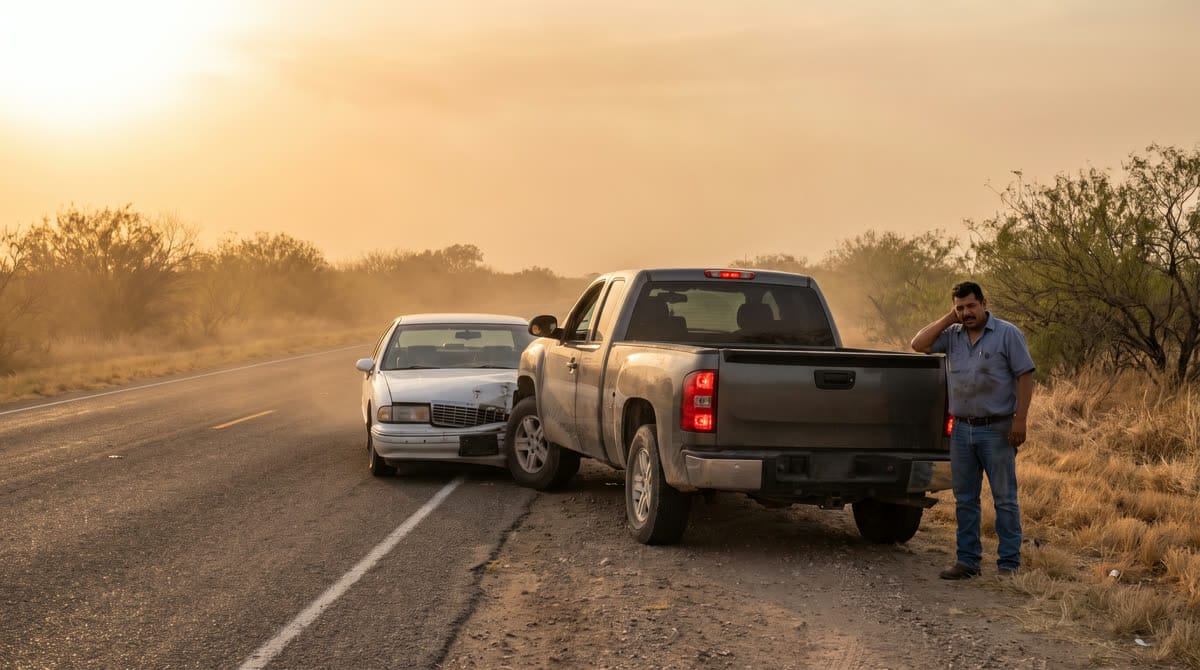
In Texas, when you are rear-ended, the driver behind you is almost always at fault because the law requires a safe following distance. But it is not automatic: the insurer may claim you braked suddenly, your brake lights were out, or you cut in. If you are assigned more than 50% of the blame, you recover nothing. See a doctor even if you feel fine: whiplash symptoms usually show up 24 to 72 hours later.
You're stopped at a light on Main Street, or slowing down on Highway 57 because traffic came to a halt, and suddenly you feel the hit from behind. You get out, see the bent bumper, the other driver says 'it's nothing,' and with adrenaline running you answer that you're fine. Two days later you can't turn your neck. And when you call the insurance company, the conversation isn't as simple as you expected. This article explains how fault is decided in a Texas rear-end crash, when the insurer tries to blame you, and what to do in the first 72 hours to protect your case.
Is the rear driver always at fault in Texas?
Almost always, but not because of an automatic rule. The Texas Transportation Code requires every driver to keep an assured clear distance from the vehicle ahead so they can stop safely, considering speed, traffic and road conditions. If someone hits you from behind, the logical conclusion is that they were too close, too fast or distracted. That's why, in practice, the rear driver's insurer usually accepts responsibility.
But notice the key word: usually. There is no Texas law that says 'the rear driver always pays.' Fault is decided case by case, with evidence. And that leaves room for the other driver's insurer to look for arguments that shift part of the blame onto you.
The 3 excuses insurers use to blame you
When the rear driver's insurer calls, their job is to pay as little as possible. These are the three stories they most often try to build:
- 1'They stopped suddenly for no reason.' They claim you stopped abruptly without cause, or braked on purpose. If you braked because a pedestrian crossed, an animal ran out or traffic stopped, that isn't your fault. But without witnesses or video, it's your word against theirs.
- 2'Their brake lights weren't working.' If one bulb was out, they'll say the other driver had no way to know you were stopping. That's why you should photograph your entire car the day of the crash, including the taillights.
- 3'They cut in' or 'they were backing up.' If you had just changed lanes or were pulling out of a parking spot, they'll argue you created the situation. In chain-reaction crashes, each insurer also tries to blame the car behind to avoid paying.
Texas follows modified comparative negligence: you can recover as long as your share of fault is 50% or less, and your recovery is reduced by that percentage. If you are assigned 51% or more, you get nothing. When the insurer says 'let's split it 50/50,' they aren't being generous: they're cutting your compensation in half and putting you one point away from zero.
'It was just a tap, I'm fine': the most expensive mistake
Rear-end crashes rarely look serious. They happen at low speed, the bumper absorbs part of the impact, and both cars can usually drive away. Your body doesn't experience it the same way. At the moment of impact your head snaps back and then forward like a whip. That's whiplash, the most common injury in this type of crash, and it can happen at 10 or 15 miles per hour.
What makes whiplash treacherous is that symptoms usually appear 24 to 72 hours later, once the adrenaline wears off. Neck pain and stiffness, headaches starting at the base of the skull, dizziness, tingling in the arms or hands, upper back pain, trouble concentrating. In some cases the impact hides something more serious: a herniated disc or a concussion.
Here's the trap: if you said 'I'm fine' at the scene and waited a week to see a doctor, the insurer will argue your injury didn't come from the crash, or that it wasn't serious. Seeing a doctor the same day or the next isn't overreacting, it's creating a record. A medical file dated close to the accident is the evidence that connects the impact to your injury.
Don't let that stop you. At Ruiz & Associates we connect you with doctors who treat you now, with nothing paid up front; their fees are covered from the final settlement of your case. You get the treatment you need and your case is documented from day one.
What to do in the first 72 hours after being rear-ended
- 1Call the police, even if the other driver insists on 'handling it between us.' In Texas a report is required when there are injuries or damage over $1,000, and a bent bumper almost always exceeds that. The official report is your first piece of evidence that you were the one hit.
- 2Photograph everything: both cars from several angles, license plates, position on the road, skid marks, the traffic light or sign, and your taillights working.
- 3Get witness information. Someone who saw you stopped when you were hit is worth more than any insurer's argument.
- 4Don't say 'I'm fine' or 'it's nothing.' Tell the truth: that you'll get checked. What you say at the scene can show up later in the file.
- 5See a doctor that day or the next, even if nothing hurts yet. Explain that you were rear-ended.
- 6Don't give a recorded statement to the other driver's insurer without advice. Adjusters are trained to ask questions that get you to accept part of the blame.
- 7Keep everything: receipts, prescriptions, missed work days, messages with the insurer.
What if the driver who hit me has no insurance?
It happens more than you'd think, especially along the border. If the rear driver has no insurance, or only carries the Texas minimum (30/60/25: $30,000 per injured person, $60,000 per accident and $25,000 in property damage), your own policy may respond if you have uninsured/underinsured motorist coverage (UM/UIM). Many people have it and don't know. Check your policy or ask us to review it with you.
What if I was partly at fault too?
Don't rule yourself out. Even if one of your lights was out or you braked hard, the rear driver still had the duty to keep a safe distance. In most cases, the majority of the responsibility stays with them. What matters is that nobody sets that percentage without someone defending your version with evidence: the police report, photos, witnesses and your medical records.
How long do I have?
In Texas you generally have two years from the date of the accident to file an injury lawsuit. It sounds like plenty, but evidence disappears fast: business camera footage is erased within days, witnesses forget, and injuries without early treatment are harder to tie to the crash. The sooner you act, the stronger your case.
How Ruiz & Associates helps
For more than 30 years we have represented families in Eagle Pass, Maverick County, Del Rio, Uvalde, Carrizo Springs and across Texas in car accidents. In a rear-end crash, our job is to shut the door on the insurer's excuses: we obtain the police report, secure video and witnesses, document your injury with doctors who treat you even without insurance, and negotiate from a position of strength. We speak Spanish, we answer personally, and we work on contingency: you pay nothing unless we win your case. The consultation is free.
Frequently asked questions
If I was rear-ended, is it automatically the other driver's fault?+
Almost always, because in Texas the rear driver must keep a safe following distance. But it isn't automatic: the insurer may claim you braked suddenly, your lights were out, or you cut in. Fault is decided with evidence.
Can I still recover if I'm assigned part of the fault?+
Yes, as long as your share is 50% or less. Your recovery is reduced by that percentage. At 51% or more you recover nothing, which is why every point matters.
I felt fine and now my neck hurts. Is that normal?+
Yes. Whiplash symptoms usually appear 24 to 72 hours after the impact. See a doctor as soon as you notice symptoms and mention that you were rear-ended.
Should I call the police for a minor rear-end crash?+
Yes. In Texas a report is required if there are injuries or damage over $1,000, and the official report is the strongest evidence of how the crash happened.
What if the driver behind me has no insurance?+
Your own uninsured/underinsured motorist coverage (UM/UIM) may respond if you carry it. Check your policy or ask us to review it; the consultation is free.
Is this your case? We cover it in depth
Every city has its own roads, hospitals and courts. If your accident happened in one of these, here's what applies where you are:
Were you in an accident? Tell us what happened.
Free, confidential consultation. No fee unless we win. Bilingual team available 7 days a week.
This article is for informational purposes only and does not constitute legal advice. Every case is different; past results do not guarantee future outcomes. Reading this content does not create an attorney-client relationship.